
 Joris Deene
Offering a cheaper perfume “inspired by” a well-known fragrance may seem like a clever marketing ploy, but it is legally very risky. On March 24, 2026, the presiding judge of the Dutch-language Commercial Court in Brussels ruled that two Belgian perfume retailers were guilty of both trademark infringement as unfair comparative advertising, and issued them with a cease-and-desist order covering the entire European Union. L’Oréal thus prevailed across the board against Pyramid Products and BP-Cosmetics.
The facts
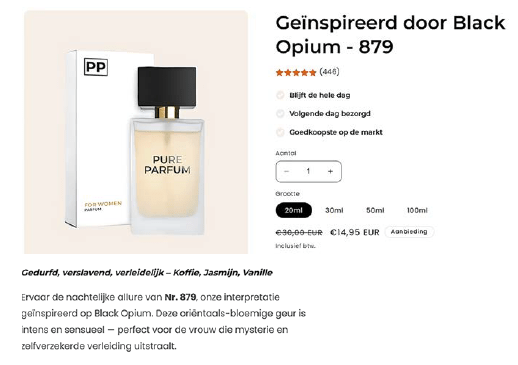
L’Oréal is the owner or exclusive licensee of dozens of registered trademarks for perfumes, such as Black Opium and Coco Mademoiselle. Two Belgian companies, Pyramid Products and BP-Cosmetics, sold their own, much cheaper perfumes through websites such as pureparfum.nl, pyramidpro.eu, blackpoint.be, and parfen.be.
For each of these perfumes, they stated that it was “inspired by” a specific brand-name perfume. They used matching tables: customers could search by the name of a well-known brand and would then be directed to the corresponding private-label product number. The websites also stated that customers would get “the same fragrance notes” and that the result was “remarkably similar” to the original, at a fraction of the price.
L’Oréal argued that this infringed on its brands and violated the rules on comparative advertising. The sellers disputed this and, among other things, filed a counterclaim seeking ten million euros in damages.
The decision
The presiding judge, acting as a judge in summary proceedings, ruled in L’Oréal’s favor on all counts.
First the advertising question, then the brand question
The judge first addressed the issue of comparative advertising. Based on the ruling L’Oréal/Bellure According to the Court of Justice, a trademark owner cannot object to the use of a sign that complies with the rules governing permissible comparative advertising (CJEU June 18, 2009, C-487/07, L’Oréal v. Bellure, para. 54). If the comparative advertising defense is successful, the trademark infringement is negated.
Article VI.17, §1 of the Code of Economic Law (WER) lists the conditions that comparative advertising must cumulatively satisfy. The court found that the sellers did not compare their perfumes in an objective, verifiable manner (condition 3°). Claims about scent depend on subjective tastes and preferences and are not objectively verifiable. Worse still: by using the phrase “inspired by” and their own reviews (“smells exactly like the original”), the sellers positioned their product as a fragrance imitation of the brand-name perfume. This also violates the conditions that advertising must not derive an unfair advantage from the brand’s reputation (7°) and must not present the product as an imitation or counterfeit (8°).
Trademark Infringement
Now that the exception for permissible comparative advertising had been eliminated, the way was clear for the trademark infringement. The court found a twofold infringement. Pursuant to Article 9, paragraph 2, subparagraph a of the Union Trademark Regulation (UMVo) and Article 2.20, paragraph 2, subparagraph (a) of the Benelux Convention on Intellectual Property (BVIE) The sellers used identical marks for identical goods, namely perfume. The defense that “inspired by” constituted merely descriptive use was, according to the court, unfounded: under the judgment Hölterhoff Referential use is permitted only if it remains purely descriptive, and not when the trademark is used for advertising purposes to stimulate sales (ECJ May 14, 2002, C-2/00, Hölterhoff v. Freiesleben; ECJ June 18, 2009, C-487/07, L’Oréal v. Bellure, para. 62).
In addition, the court found a violation of Article 9(2)(c) of the UMVo and Article 2.20(2)(c) of the BVIE, which provide protection for a well-known trademark. Anyone who advertises a product as an imitation automatically derives an unjustified advantage from the reputation of the trademark (L’Oréal v. Bellure, para. 79).
The Measures and the Costs
The court ordered the suspension of operations throughout the European Union, subject to a penalty of 5,000 euros per violation per website per day, with a cap of 500,000 euros per company. Because the sellers are based in Belgium, an injunction based on EU trademarks can extend to the entire territory of the Union.
Noteworthy is the litigation fee of 23,546.51 euros. The judge presiding over the preliminary injunction proceedings declared that he lacked jurisdiction over the counterclaim for damages of ten million euros, but nevertheless calculated the fee based on that amount. According to the judge, the compensation is calculated based on all claims brought before the court, including those over which he has no jurisdiction.
Legal analysis and interpretation
Why the Order of Reasoning Underpins the Entire Judgment
The real crux of this ruling lies not in the trademark infringement itself, but in the order in which the court addresses the issues. Comparative advertising is not a secondary defense but a full-fledged exception: advertising that meets all the conditions renders the use of the trademark lawful, no matter how identical the sign may be. The court therefore had to rule on the advertising issue first, because a positive answer would have immediately nullified the trademark claim.
That is precisely where the weakness of every “inspired by” model lies. As soon as the advertisement presents the product as a fragrance imitation, it can no longer be objective—and therefore lawful. And as soon as it is unlawful, the exception no longer applies, and trademark infringement is a foregone conclusion. The two principles reinforce each other: the imitative nature that renders the advertisement unlawful is precisely the element that gives rise to the unjustified advantage under Article 9(2)(c) of the UMVo and Article 2.20(2)(c) of the BVIE. The Bellure ruling had already established that connection, and this judgment faithfully follows suit.
The line between referring and linking
It is interesting to see how the court applies the distinction between descriptive and free-riding use. The sellers invoked the Hölterhoff ruling, in which the Court of Appeal accepted that a trademark may be referred to verbally to an informed professional without constituting infringement. However, that ruling applies to a purely informational situation. In this case, the sellers used the trademark in public advertising, with search functions and cross-reference tables that led customers directly to the well-known perfume. That is not referring to a characteristic; it is free-riding on the trademark’s reputation.
In doing so, the court follows the established principle that “use as a trademark” is interpreted broadly and that the mere fact that only the scent is imitated—and not the bottle—makes no difference (L’Oréal v. Bellure, para. 76). The message for anyone seeking to hide behind a referential or descriptive use is this: it is the advertising context that matters, not the label the seller affixes to the product.
Litigation Costs as a Litigation Risk
The third point deserves attention because, while it is unrelated to intellectual property law, it clearly illustrates the risk of litigation. The sellers themselves filed a counterclaim seeking ten million euros in damages. That claim had no chance of success before the preliminary injunction judge, who lacks jurisdiction to rule on damages. Yet it was precisely that amount that determined the litigation costs they were required to pay to the prevailing party. Anyone who files a sky-high counterclaim with a court that cannot rule on it thus increases their own cost risk without any chance of gain. This serves as a warning to every party to a lawsuit.
Specifically, what does this mean?
For sellers of alternative or “dupe” products. You may sell a cheaper alternative, but you may not ride on the coattails of a well-known brand. Avoid any wording that suggests your product “smells the same,” “is indistinguishable,” or “is inspired by” a brand. Correlation tables and search functions based on brand names are also risky: they explicitly confirm the imitative nature of the product, which makes the advertising illegal and constitutes trademark infringement. If you wish to make comparisons, do so based on objectively verifiable characteristics (composition, shelf life measured according to a standard, price), not on subjective impressions of scent. Finally, be cautious with counterclaims: an inflated claim for damages filed with an unauthorized court only increases your own cost risk.
For trademark owners. The ruling confirms that combining a trademark claim with a claim for unfair comparative advertising is highly effective. Gather evidence of the imitation claims yourself: the product pages, the search functions, the matching lists, and especially the customer reviews highlighted by the seller. That communication from the seller itself provides proof that imitation is taking place, meaning you no longer need to demonstrate specific damages. If you are relying on EU trademarks and the opposing party is based in Belgium, the cease-and-desist order can apply throughout the entire European Union.
Frequently asked questions (FAQ)
Can I sell a perfume that resembles a well-known brand?
Developing and selling a similar perfume is not prohibited in and of itself. What is not allowed, however, is to present your product in advertising as an imitation of or as “inspired by” a well-known brand. As soon as you make that connection, you are committing both trademark infringement and unfair comparative advertising.
Is “inspired by” allowed as an advertising slogan?
Not in this case. The judge ruled that “inspired by” gives the average consumer the impression that they are buying a fragrance imitation. This violates the conditions for permissible comparative advertising set forth in Article VI.17 of the WER and results in an unjustified advantage derived from the brand’s reputation.
Can a Belgian court issue a ban that applies throughout the European Union?
Yes. When an injunction is based on EU trademarks and the infringer is established in Belgium, the injunction may extend to the entire territory of the EU.
Conclusion
The “inspired by” model directly conflicts with both trademark law and the rules on comparative advertising: the imitative nature that renders the advertisement unlawful also constitutes trademark infringement. For those offering alternative products in Belgium, this is a costly lesson; for trademark owners, it is an effective enforcement tool.





 Dutch
Dutch  English