
 Joris Deene
When soccer prodigy Lamine Yamal recently won the World Cup with Spain—at the expense of Lionel Messi—an AI parody immediately surfaced: a reversal of the iconic 2007 photo in which Messi held the six-month-old baby Yamal in a bathtub. In the new version, it is Yamal who is giving Messi a bath, and it is clear to everyone that it is a joke. Nevertheless, the answer to the question in the title is: yes, even a blatantly obvious parody must be recognizable as AI content under the AI Regulation, although a less stringent transparency regime applies in such cases. The guidelines published by the European Commission on July 20, 2026, clearly outline the scope of that obligation.
The reason: an upside-down bath photo
In 2007, photographer Joan Monfort took a photo that has taken on a life of its own ever since. For an FC Barcelona calendar campaign, Messi held baby Yamal in a baby bathtub. More than eighteen years later, Yamal is considered the greatest soccer talent in the world, and after he outplayed Messi in the final, an AI-generated parody reversed the roles.
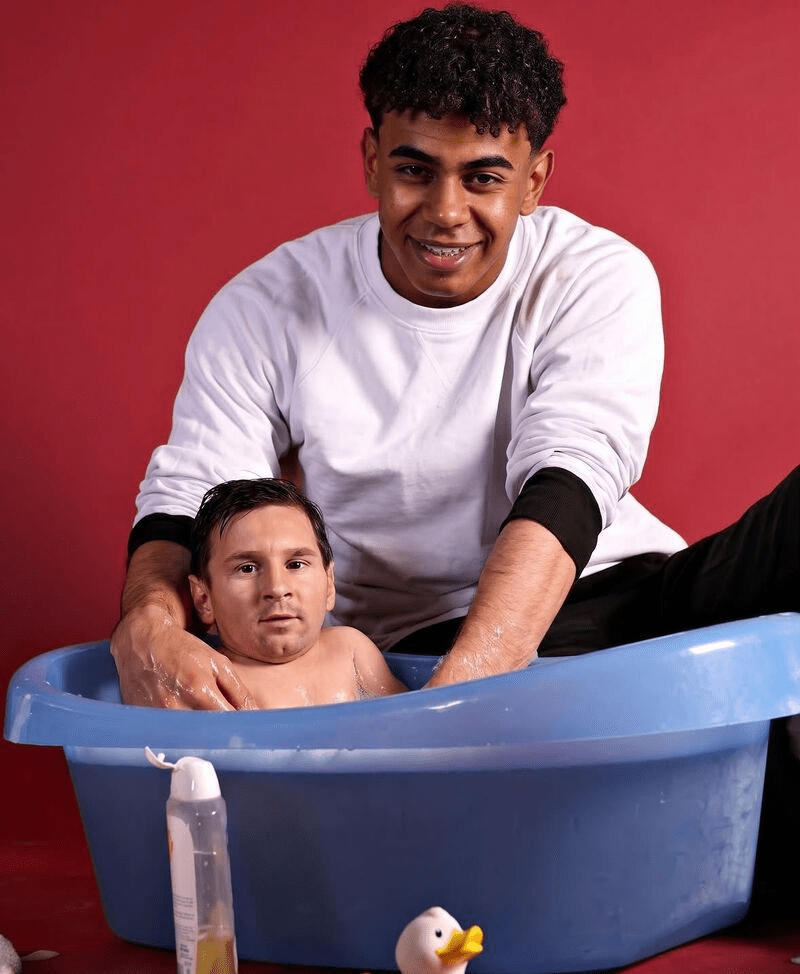
The question is not whether the joke is funny, but whether it makes it legally clear enough that AI was involved. It was precisely on that point that the European Commission issued its guidelines regarding the transparency requirements of Article 50 of the AI Act, formally known as Regulation (EU) 2024/1689 on artificial intelligence. These guidelines are not binding, but they will serve as the starting point once the transparency rules take effect on August 2, 2026.
Is this parody actually a deepfake?
Article 50(4) of the AI Regulation deals with deepfakes. According to the regulation, a deepfake is AI-generated or manipulated image, audio, or video content that mimics existing persons, objects, places, entities, or events and falsely appears to be real or authentic. The guidelines break this down into four conditions: a resemblance to something that exists—a person, object, or place—and a false appearance of authenticity.
The first three criteria are easily met here. The image depicts two real, recognizable people and renders them in a photorealistic manner. The fourth criterion is the tricky one: does the content appear to be real when it isn’t?
The guidelines make it clear that this test is objective and does not require an intent to mislead. The decisive factor is whether the reasonably foreseeable target audience could mistake the content for the real thing. When content is shared on social media, this target audience also includes those who are unfamiliar with the context, including young or less digitally literate viewers. To them, even an image intended as a joke may appear real, which means it still qualifies as a deepfake.
It is important to note that, with regard to deepfakes, there is no exception for cases where the artificial nature is evident. That exception applies only to the chatbot requirement under Article 50, paragraph 1. In the case of deepfakes, therefore, the clearly evident prank-like nature does not lead to an exemption, but at most to a less stringent regime.
The dual transparency requirement
The AI Regulation imposes two obligations regarding deepfakes on two different parties.
The provider of the AI system must mark the generated or manipulated output with a machine-readable label (Article 50, paragraph 2). This label is hidden from view and is intended for detection tools, not for the naked eye.
The user who uses the deepfake for professional purposes—the deployer—must also disclose, in a manner visible or audible to the public, that the content has been generated or manipulated by AI (Article 50, paragraph 4). The guidelines emphasize that the deployer may not rely solely on the provider’s machine-readable label for this purpose, as that label is not clearly perceptible to the public.
Does this obligation also apply to a joke?
Yes, but in a more lenient form. For deepfakes that are part of works that are clearly artistic, creative, satirical, or fictional, the regulation limits the disclosure requirement to a manner that does not interfere with the viewing or enjoyment of the work.
Two points deserve attention. First, the artistic, creative, or satirical nature must be apparent. The guidelines interpret that term strictly: content whose nature is unclear or ambiguous falls outside the more lenient regime. Whether the upside-down bath photo is clearly a creative or satirical edit to every viewer is precisely where the uncertainty lies. Taken out of context from the original photo and posted on a timeline without a caption, the image may remain ambiguous to some viewers.
Second, even under the more lenient regime, a disclosure is still required. The regime does not eliminate the obligation; it merely makes it less intrusive, so that the enjoyment of the work remains intact. A discreet but noticeable indication that the content is AI-generated therefore remains necessary.
Personal or professional: who needs to label?
The key question is whether the deepfake is used for professional purposes. The regulation does not apply to natural persons who use an AI system solely for personal, non-professional activities (Article 2, paragraph 10). The guidelines provide the following explicit example: a private individual who creates a deepfake using AI and posts it on social media falls under that exception.
If a private individual created and posted the bath photo parody purely for personal enjoyment, then he is not subject to any labeling obligation as a distributor. The provider of the AI tool used remains obligated to include the machine-readable mark; that obligation does not disappear simply because the use was personal.
Conversely, if a media company, a marketer, or an influencer uses the same parody for professional purposes, the disclosure requirement under Article 50, paragraph 4, applies in full, albeit under the less stringent regime for creative or satirical works.
What about the other rights?
The guidelines explicitly warn that the less stringent transparency regime is not a free pass. The rights and freedoms of third parties must continue to be respected, even in the case of a deepfake that is clearly intended to be humorous or artistic.
Specifically, there are at least three other factors at play here. The original photo from 2007 may be protected by copyright, which means that an adaptation is not a given. The soccer players pictured can rely on their image right and the protection of their privacy. And because this involves identifiable living individuals, the the General Data Protection Regulation (GDPR) also comes into play.
An AI label does not solve that problem. As the guidelines state: applying a label does not suddenly make content that is unlawful for other reasons lawful. The obligation to be transparent and the lawfulness of the content are two separate issues.
Specifically, what does this mean?
For anyone who shares AI-generated content on social media. Purely personal and non-commercial use is exempt from the labeling requirement for distributors. As soon as there is a commercial or professional purpose, that changes—even if it’s just a joke.
For media companies, marketers, and influencers. Assume that a photorealistic deepfake of real people falls under Article 50, paragraph 4. Always include a clear, visible AI disclosure, and assess on a case-by-case basis whether the less restrictive creative or satirical regime applies. Document that assessment.
For developers and providers of AI tools. You are responsible for the machine-readable marking required by Article 50, paragraph 2, regardless of who ultimately uses the output.
Finally, pay attention to the timing. The requirements take effect on August 2, 2026. Content generated before that date does not need to be labeled retroactively, and a transition period through December 2, 2026, applies to the machine-readable labeling of existing systems by providers. Noncompliance can result in fines of up to 15 million euros or 3 percent of global annual revenue, whichever is higher.
Frequently asked questions (FAQ)
Do I need to label an AI meme that I post on social media just for fun?
For purely personal, non-professional use, the labeling requirement does not apply to users. However, as soon as you use the content for professional or commercial purposes, you must clearly indicate that it was created by AI.
Is a parody exempt from the transparency requirement under the AI Act?
No. For deepfakes that are clearly artistic, creative, satirical, or fictional, a less stringent regime applies, but disclosure that the content is AI-generated remains required, in a way that does not interfere with the enjoyment of the work.
Does an AI label automatically make my deepfake legitimate?
No. The label merely fulfills the transparency requirement. Copyright, image rights, and the GDPR continue to apply and may give rise to liability independently of this.
Conclusion
Even a blatantly obvious parody is not entirely exempt from transparency rules. If the deepfake is used for professional purposes, an appropriate, visible AI disclosure is still required, even though it must not interfere with the enjoyment of the work. For purely personal use, the labeling requirement for the deployer is waived, but not the marking requirement for the provider. And regardless of that, copyright, image right, and data protection continue to apply in full.


 Dutch
Dutch  English