
 Joris Deene
Yes, a competitor can claim the revocation of your trademark for products or services for which you have not used the mark in a "normal" manner for a continuous period of five years. In a ruling by the Brussels Court of Appeal of 26 June 2025, a trademark owner who sued a competitor for trademark infringement faced just such a counterclaim. The outcome underscores a crucial lesson for every entrepreneur: registering a trademark is one thing, but actively using it and being able to prove this is at least as important.
The facts: the battle between materne and olvarit
The case revolved around two giants in the food industry: Materne-Confilux NV, known for jams and compotes, among other things, and Danone Belux NV, producer of Olvarit baby food.
Materne owns a Benelux trademark, registered in 2014, which consists of a green, kidney-shaped figure containing the word "Materne." This trademark was registered for a wide range of food products in classes 29, 30 and 32.

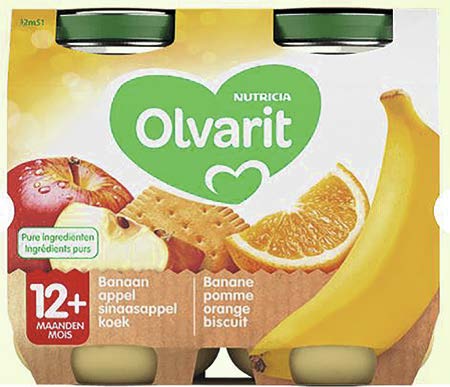
In 2016, Danone launched a new visual design for its Olvarit products, with a logo in the shape of a green heart containing the words "Nutricia" and "Olvarit." Materne felt that this new logo was too similar to her logotype and could cause confusion among consumers. She initiated proceedings to have the use of the Olvarit logo discontinued.

During the appeal proceedings, Danone reversed the roles. It filed a counterclaim and asked the court to declare Materne's trademark partially revoked because Materne had never seriously used it for many of its registered products (such as meat, fish, coffee, beer, etc.).
Appeal court decision
On 26 June 2025, the Court of Appeal in Brussels ruled in favor of Danone on all counts.
1. Counterclaim on appeal is admissible
Materne argued that the request for revocation came too late, because it was only submitted on appeal. The court dismissed this argument. A counterclaim that is first submitted on appeal is perfectly admissible as long as it has a factual connection with the original claim. Since both claims concerned the same Materne trademark, this requirement was met.
2. No likelihood of confusion between the trademarks
The crux of Materne's original claim was that the Olvarit logo would create confusion with her trademark. The court found, after a thorough comparison, that this was not the case. The main reasons were:
- Weak resemblance: Visual similarity is weak, auditory similarity non-existent and conceptual similarity (green color, heart shape) very limited, as these are banal elements in the food sector.
- Various products: The product groups overlap only slightly (only for compotes).
- Attentive consumer: Consumers of baby food (“Olvarit”) have a higher level of attention.
- Awareness of Olvarit: The word “Olvarit” itself is a well-known brand in the baby food market, which clearly distinguishes it from “Materne.”
3. Trademark infringement of a well-known trademark is not proven
Materne could not prove that its specific figurative mark (the green shape) enjoyed such a reputation that it deserved additional protection. The word "Materne" is obviously well known, but the reputation of the figurative mark itself was not proven.
4. Trademark of Materne partially revoked
This was the most far-reaching decision. The court ruled that the burden of proof for the “normal use” of a trademark lies with the trademark owner. Materne therefore had to demonstrate that it had effectively used its trademark for all claimed product categories over the past five years.
The evidence submitted by Materne—a few invoices for minimal quantities of niche products such as pickled turnips or fruit pockets—was completely insufficient to demonstrate genuine commercial use. For a large proportion of the products, no evidence was provided at all. As a result, Materne's trademark was declared revoked for a long list of products, including meat, fish, dairy products, coffee, tea, bread, beer, and mineral water.
Legal analysis and interpretation
This ruling is a textbook example of the "use it or lose it" doctrine in trademark rights. The counterclaim for revocation is a powerful defense weapon. A party accused of trademark infringement can parry the attack by questioning the validity or scope of protection of the invoked trademark itself.
The burden of proof for "genuine use" is unequivocally on the trademark owner. This use must be more than merely symbolic or for the sole purpose of preserving trademark rights. It must be aimed at creating or maintaining a market share. The assessment is rigorous: the court takes into account the size of the company and the nature of the products. For a large player like Materne, which operates in the mass consumer goods sector, a few invoices for small deliveries do not carry enough weight.
In addition, the ruling confirms that any undertaking with a legitimate interest may request revocation. The status of competitor is sufficient for this purpose; it is not necessary to demonstrate that one wishes to use a similar sign oneself. The right to have an unused trademark removed from the register is considered a subjective right that protects freedom of trade and business.
What this specifically means
- For the trademark owner: Your trademark portfolio is not a passive asset. Register your trademark only for the goods and services for which you will actually use it. Conduct periodic audits and proactively collect evidence of use (invoices, advertising flyers, Web pages, etc.) for each product category. Failure to do so creates a weakness that a competitor can ruthlessly exploit.
- For the party sued for trademark infringement: An attack is often the best defense. Investigate thoroughly whether the opposing party is actually using its trademark for the products for which protection is claimed. A well-founded counterclaim for revocation can completely overturn a lawsuit or at least provide a very strong lever of pressure in negotiations.
FAQ (Frequently Asked Questions)
What is "normal use" of a trademark?
Normal use means that the trademark is used publicly and externally to create or maintain a market for the protected products or services. The use must not be purely symbolic. The assessment depends on all circumstances, such as the nature of the product, the extent of the use, and the frequency.
How can I prove that I am using my trademark normally?
You can prove this by means of a set of documents, such as dated sales invoices (showing the scope), advertising campaigns, brochures, price lists, mentions on websites, articles in the press, and any other evidence showing that the trademark was commercially exploited in the relevant market.
Can a counterclaim for revocation still be lodged on appeal?
Yes, as this ruling shows, a counterclaim for revocation may be brought for the first time on appeal, provided that it is sufficiently related in fact to the original claim. This is the case, for example, if the claim relates to the trademark that was invoked at first instance.
Conclusion
This ruling is a clear warning: trademark protection cannot be taken for granted. It requires active and demonstrable commercial exploitation. Without proof of normal use, your carefully built trademarkd, or part of it, can simply be declared revoked after five years at the request of any interested party, such as a competitor.





 Dutch
Dutch  English