

 Joris Deene
Not just like that. According to the Court of Justice of the European Union, freedom of expression, including political parody, be a valid reason for using a sign that is identical or similar to a well-known trademark, but only when that freedom outweighs the trademark owner’s property rights in the specific case. Anyone who merely borrows a well-known trademark to amplify their own political message does not meet that threshold. That is the essence of the September 8, 2026, ruling (C-298/23) in the case between Inter IKEA Systems and the association behind the Vlaams Belang campaign, which launched its migration plan in 2022 as the “IKEA Plan: Immigratie Kan Echt Anders.” (Immigration Can Really Be Different).
In short:
- On September 8, 2026, the Grand Chamber of the Court of Justice ruled that freedom of expression may, in principle, constitute a valid ground within the meaning of the EU Trademark Regulation, the Trademark Directive, and the Benelux Convention, but that invoking that freedom alone is not sufficient.
- A third party using the well-known trademark must demonstrate why its specific reasons outweigh the interests of the trademark owner, based on its purpose and good faith, its contribution to a debate of public interest, and the consequences for the trademark.
- As applied to the Vlaams Belang campaign, the Court of Justice found that this assessment worked to the party’s disadvantage: the immigration debate had nothing to do with IKEA, the signs were nearly identical, the use was intensive, and it could give the impression that IKEA supported the message.
The facts
Inter IKEA Systems BV is the owner of four trademarks: three Benelux trademarks—including the IKEA word mark from 1971 and the well-known blue-and-yellow figurative mark from 1987—and the IKEA Community word mark from 1998. No one disputed during the proceedings that these trademarks are well known.
On November 14, 2022, Vlaams Belang presented a program for reforming asylum and migration policy at a press conference under the title “IKEA Plan: Immigratie Kan Echt Anders.” (Immigration Can Really Be Different). The speaker added that this plan did not stand for “Ingvar Kamprad Elmtaryd and Agunnaryd,” the actual meaning of the acronym IKEA. The plan consisted of fifteen proposals, described as ready to be “put together” by the government. The illustrations used symbols that matched the IKEA brand, in the same font and colors, and graphics reminiscent of the furniture chain’s assembly instructions. A more detailed program was available on the party’s website, and the press conference was widely shared on social media.
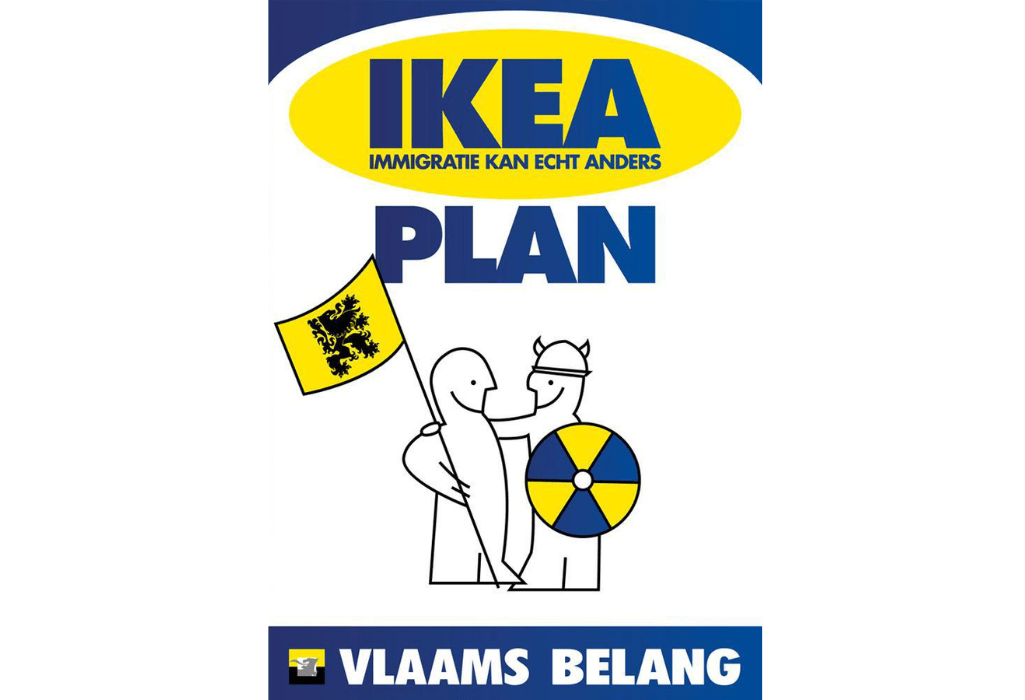
Eight days later, on November 22, 2022, Inter IKEA filed a claim for infringement with the Dutch-speaking Business Court in Brussels against the non-profit organization Algemeen Vlaams Belang, the non-profit organization Vrijheidsfonds, and several individuals representing the party. The court declared the claim admissible only against Vrijheidsfonds, the association that had conducted the campaign in the name and on behalf of the party. Vrijheidsfonds acknowledged the use and undertook to cease it until the final judgment, but argued that it had used the brands’ reputation to reinforce its message and that freedom of speech constituted a valid reason for doing so.
In response, the Business Court, in a judgment dated May 4, 2023, referred a question for a preliminary ruling to the Court of Justice: Can freedom of expression, including political opinions and political parody, constitute a valid reason, and what criteria must the national court take into account in that case? Inter IKEA filed an appeal against that referral judgment, but the appeal was declared inadmissible, so the Court of Justice considered itself bound by the referral. Advocate General Szpunar took on November 13, 2025 conclusion: The Grand Chamber's ruling followed on September 8, 2026.
The ruling
The Court of Justice addresses the issue in four steps: the applicable legal framework, whether freedom of expression can constitute a valid ground, the balancing criteria, and the special Benelux provision regarding non-trademark use.
The applicable framework: use in commercial transactions for goods or services, or other use
A well-known trademark is a trademark that is known to a significant portion of the relevant public and therefore enjoys broader protection than an ordinary trademark: the owner may take action against any use of an identical or similar sign that, without valid reason, takes unfair advantage of or is detrimental to the distinctive character or reputation of the trademark, even in relation to entirely different goods or services. That protection is set forth in Article 9, paragraph 2, (c) of the Union Trademark Regulation and, for national and Benelux trademarks, in Article 10, paragraph 2, (c) of the Trademark Directive. Both provisions require that the third party use the mark in the course of trade and in connection with goods or services.
In addition, Article 10(6) of the Trademark Directive allows Member States to protect a well-known trademark against use “other than to distinguish goods or services.” The Benelux has done so in Article 2.20(2)(d) of the Benelux Convention on Intellectual Property. That provision applies only to the three Benelux trademarks, not to the EU trademark.
The referring court had not determined the legal basis for Vrijheidsfonds’s use. The Court of Justice therefore sets forth the criteria. Use in the course of economic activity means any use in a commercial activity aimed at obtaining an economic advantage, outside the private sphere. A nonprofit association may fall within this definition when it acts as a market participant, as the Court of Justice previously ruled in the Verein Radetzky-Orden ruling (ECJ, December 9, 2008, C-442/07). It is noteworthy that Vrijheidsfonds itself admitted at the hearing that its use took place in the course of economic activity, as it sought to obtain an economic advantage. A political program is neither a good nor a service in and of itself, but affixing the mark to advertising materials or using it in promotional online content may constitute use in connection with goods or services. The Brussels court must determine this.
Freedom of speech as a valid reason for using a well-known trademark
A valid reason is a defense by which a third party using a well-known trademark may avoid the trademark owner’s right to prohibit such use, even when that use benefits from or detracts from the reputation of the trademark. The term is not defined in trademark law. The Court of Justice reiterates its ruling in Leidseplein Beheer (Court of Justice of the European Union, February 6, 2014, C-65/12): The concept encompasses not only objectively compelling reasons but may also take into account the user’s subjective interests, and it aims to strike a balance between the interests of the holder and those of the third party.
The Court of Justice then frames the conflict in terms of fundamental rights. Trademark law falls under the right to property set forth in Article 17(2) of the Charter of Fundamental Rights of the European Union, but that right is not absolute and must be balanced against the freedom of expression guaranteed by Article 11. The recitals of both the regulation and the directive emphasize that trademark law must be applied with full respect for that freedom, a point the Court of Justice had previously underscored in its judgment in Constantin Film Produktion (Court of Justice of the European Union, February 27, 2020, Case C-240/18 P). The conclusion is that freedom of speech can, in principle, constitute a valid reason.
However, there is a significant caveat. Merely invoking freedom of speech is not sufficient, because otherwise any use of a well-known trademark could be justified on that basis, and the concept of “valid reason” would be undermined. The third party must set forth the specific reasons for its use that are related to the exercise of that freedom and demonstrate that those reasons outweigh the rights and interests of the trademark owner. The burden of proof therefore lies with the user, as was already established in the Intel Corporation decision (ECJ, November 27, 2008, C-252/07).
The criteria for balancing the right to property and freedom of speech
The national court must weigh all the circumstances of the case. The Court of Justice classifies them into three groups.
First, the intent of the third party. Anyone who uses the sign to disparage the trademark, or with the sole purpose of riding on the coattails of the well-known trademark, has no valid reason: that is precisely what the provision seeks to prohibit. The use must be made in good faith and motivated by the desire to exercise freedom of expression. This is particularly the case when the trademark is used to express an opinion about the trademark itself, the owner, its business practices, or its goods or services; when the use initiates or fuels a debate of public interest; or when the use is necessary for other reasons, for example, because a component of the trademark has a linguistic meaning or because the trademark has become a public cultural reference.
Second, the nature of the expression. If it contributes to a debate in the public interest, then, according to the case law of the European Court of Human Rights, there is little room for restrictions, whereas Member States have a wide margin of discretion when it comes to commercial communications, as is evident from the Ashby Donald ruling (ECHR, January 10, 2013, No. 36769/08). Satire and parody, moreover, deserve special attention because, by definition, they exaggerate and provoke, as the Strasbourg Court held in the Eon ruling (ECHR, March 14, 2013, No. 26118/10).
Third, the consequences for the trademark owner. Anyone who demonstrates a valid reason does not acquire their own right to the sign, but obligates the owner to tolerate the use and a certain amount of harm. However, the owner cannot be required to tolerate disproportionate harm or an infringement of the essence of their exclusive right. Relevant factors include the intensity, scope, and manner of the use; the degree of recognition of the trademark; the degree of similarity between the sign and the trademark; and—a new consideration in case law— whether the use could create the impression that the proprietor supports the political message, when in fact the proprietor wishes to remain politically neutral or actually rejects that message.
The application to the Vlaams Belang campaign
The Court of Justice does not limit itself to abstract criteria. IKEA is an acronym formed from proper nouns with no linguistic meaning, and there is nothing to suggest that it has become a cultural reference or a word in everyday language. Vrijheidsfonds did not use the trademarks to spark a debate about IKEA or its products. While the immigration debate is a matter of public interest, it has no connection whatsoever to the IKEA trademarks, so the use is limited to riding on the coattails of those trademarks.
Furthermore, the symbols were nearly identical to the trademarks—using the same font and colors as the logo—and this was not a one-time use at a press conference but rather repeated use with distribution on the internet to a potentially unlimited audience. Despite the explicit denial during the press conference, the Court of Justice held that it cannot be ruled out that the public was led to believe that IKEA endorsed the message. The conclusion, subject, in each case, to verification by the Brussels court, is that use intended solely to exploit the reputation of the trademarks to reinforce and disseminate a political message does not appear to outweigh the rights of the trademark owner and therefore does not appear to constitute a valid justification.
The Benelux provision regarding use other than to distinguish goods or services
If the Business Court concludes that the use did not take place in the course of trade for goods or services, it must assess the three Benelux trademarks solely in light of Article 2.20, paragraph 2(d) of the Benelux Convention. The Court of Justice holds that the concept of “valid reason” has the same meaning there, with the same criteria for assessment. It does, however, add that, according to the European Court of Human Rights, the exercise of freedom of expression outside the commercial sphere may enjoy broader protection, so that the balancing test under that ground does not necessarily yield the same result. In this case, however, the Court of Justice does not see how this difference has any bearing.
Legal analysis and interpretation
The Court of Justice is more lenient than its Advocate General, and that is a genuine policy choice
Advocate General Szpunar had proposed a stricter rule to the Court of Justice. According to his Opinion of November 13, 2025 anyone invoking freedom of speech must demonstrate that their statement targets the trademark, the owner, or the owner’s goods or services, or that the owner has already become involved in the debate in question through their own conduct. In his view, a political program that says nothing about the trademark could never be justified on the grounds of freedom of speech. Viewed in this light, the IKEA plan would have stumbled at the very first hurdle, without further consideration.
The Court of Justice does not adopt that requirement. In the ruling, a connection to the trademark or its owner is one of the circumstances indicating good faith, alongside the contribution to a debate of public interest and the necessity of the use. The absence of that connection carries significant weight but does not preclude the defense. This is no minor detail. A parody that uses a well-known trademark as a vehicle to comment on society—rather than on the trademark itself—remains, in principle, defensible, provided that the user prevails in the balancing test. In the case itself, this changes little, because the Court of Justice ultimately ruled against Vlaams Belang in the balancing test; however, for future cases, it leaves the door ajar that the Advocate General sought to close.
One counterargument puts the significance of that loophole into perspective. The Court of Justice requires that the use be “necessary” for the exercise of that freedom when it does not concern the trademark and does not fuel debate, and it accepts that the trademark owner should not have to suffer disproportionate harm. Anyone who uses a well-known trademark for a message that has nothing to do with it will almost always be confronted with the question of why they needed that particular trademark. A campaigner rarely has any other answer to that question than the attention the trademark generates, and according to the ruling, that answer is precisely not a valid reason. The loophole is therefore real but narrow, and in practice, it will mainly come into play when the trademark has become part of everyday language or has become a cultural reference.
The Benelux Court of Justice’s Dom Pérignon ruling is largely outdated
The referring court pointed to a discrepancy within the Benelux. Belgian courts have traditionally interpreted the concept of “valid reason” very narrowly, whereas the Benelux Court of Justice, in its decision in Moët Hennessy Champagne Services v. Cedric Art (BenGH, October 14, 2019, A 2018/1) had formulated a very broad rule: artistic freedom is a valid reason for use other than as a trademark when the artistic expression is the original result of a creative design process that is not intended to cause harm to the trademark or its owner. In practice, this meant that only the intent to cause harm could be held against an artist. Legal scholars criticized this, in part because the ruling did not provide any criteria for weighing the interests involved and left it unclear whether different rules applied to political expressions (M.-C. JANSSENS, note under BenGH October 14, 2019, RW 2019-2020, 1369).
The ruling of September 8, 2026, replaces that “test of intent” with a full-fledged balancing test comprising at least seven considerations, and it expressly declares that this balancing test also applies to the Benelux ground for use other than as a trademark, because the concept of “valid reason” must have the same meaning there as it does in the directive. Anyone who still relies on the Dom Pérignon ruling today will therefore get no further than the finding that freedom of expression is a relevant consideration; the Court of Justice now sets the standard for whether it prevails in the specific case. For artists, however, there is a nuance: the Court of Justice recognizes that expression outside the commercial sphere is protected more broadly, so that a painting may be assessed differently than a political pamphlet or an advertising campaign.
There is also a methodological lesson to be learned. The questions posed to the Benelux Court of Justice were almost word-for-word the same as those now submitted to the Court of Justice. Since “valid reason” is a concept under harmonized EU law, they should have been posed at that time in Luxembourg, to the other court. The fact that the Dutch-speaking Business Court in Brussels, acting as the court of first instance this time, referred the matter directly to the Court of Justice has spared the Benelux seven years of uncertainty that might otherwise have dragged on all the way to the Court of Cassation.
Did the Court of Justice go too far by assessing the facts itself?
A preliminary ruling under Article 267 of the Treaty on the Functioning of the European Union serves to interpret Union law, not to apply it to the facts of the case. Nevertheless, in paragraphs 94 through 101 of the ruling, the Court of Justice assesses the Vlaams Belang campaign in detail: the absence of linguistic meaning, the nearly identical signs, the repeated use, the dissemination on the internet, and the risk that the public will associate IKEA with the message. The conclusion that the use “does not appear” to outweigh the interests of the trademark owner leaves the Brussels court formally free to decide, but in practice gives it little leeway to rule otherwise. A preliminary critical reading therefore suggests that the Court of Justice has stretched its jurisdiction, and that such restraint was all the more warranted given the political sensitivity of the case.
That criticism carries weight, but it is not decisive. The Court of Justice is doing nothing other than what it did in the Leidseplein Beheer ruling and in the Deckmyn copyright ruling (Court of Justice of the European Union, September 3, 2014, Case C-201/13): provide the referring court with a useful answer by applying the criteria to the facts set forth in the order for reference, subject to verification in each case. Moreover, the outcome before the Court of Justice is already largely determined by Vrijheidsfonds’s own position, as it admitted at the hearing that it was acting in the course of economic activity and that it intended to use the trademarks’ reputation to reinforce its message. Anyone who claims to be riding on the coattails of a trademark can hardly blame the Court of Justice for taking that statement seriously. And for national courts, this concrete application has a major advantage: they now know not only which criteria apply, but also how much weight each criterion is given in a typical case.
The Deckmyn ruling deserves a brief mention, as it concerned the same organization. In 2011, Vlaams Belang distributed a calendar on which the cover of the Suske en Wiske album *De Wilde Weldoener* had been redrawn to feature the mayor of Ghent and veiled figures. The Court of Justice described the parody at the time as an expression that evokes an existing work with clear differences and contains humor or satire, and it recognized the rights holders’ constitutionally protected interest in not being associated with a discriminatory message. Fifteen years later, trademark law has reached the same conclusion: the risk that the public will associate the trademark owner with the political message is now also an explicit criterion for establishing valid grounds. The difference is that copyright law, in Article 5, paragraph 3, k) of the InfoSoc Directive has a genuine exception for parodies, whereas the European Parliament did propose a similar exception for trademark law in 2014 but was unable to get it adopted. The “valid reason” exception fills that gap, but places the burden of proof on the user.
Specifically, what does this mean?
For holders of well-known trademarks. The ruling strengthens your position against the use of your trademark in campaigns with which you wish to have no association, even when those campaigns invoke a social debate. Document your political neutrality or the positions you have publicly taken, because the question of whether the public might get the impression that you support the message is now a fully valid criterion. Record the intensity of the use—the number of posts, the channels, the reach, and the duration—because the Court of Justice explicitly distinguishes between a one-time press conference and repeated online dissemination. If you are unsure whether a campaign that uses your brand falls under well-known trademark protection, that is the first thing we will verify for you.
For political parties, organizations, and campaigners. Freedom of speech does not give you carte blanche to use a well-known brand as an eye-catcher. Ask yourself three questions before launching a campaign. Is the message about the brand, the company, or its products? Is the brand necessary for the message—for example, because it has become a term in everyday language? And how closely do you stick to the original? Someone who merely borrows the word and chooses their own design is in a stronger position than someone who copies the font, colors, and visual style. According to the Court of Justice, an explicit denial of any connection—such as the comment about the actual meaning of the acronym made during the press conference—is not sufficient to dispel the impression of endorsement. Also keep in mind that a nonprofit organization engages in economic activity as soon as it acts as a market participant, and that party financing linked to election results may, according to the Advocate General, contribute to that classification. Anyone wishing to build a campaign around a well-known brand would be well advised to seek assistance in advance from a lawyer specializing in trademark law.
For artists, satirists, and publishers. The ruling does not weaken your position; rather, it clarifies it. The broad wording of the Dom Pérignon ruling has been replaced by a balancing test that takes into account your good faith, the work’s contribution to a debate, the non-commercial nature of the expression, and the distance from the trademark. A work of art that takes the trademark itself as its subject and is exhibited outside of commercial contexts remains the strongest case. A parody that merely uses a well-known logo to convey a different message is the weakest, as was also evident in copyright law in the a redrawn cover of a children's book that a weekly magazine used to defend as a parody. The point that the judge may weigh the facts differently outside the commercial sphere is, for you, the most important sentence in the ruling.
Frequently asked questions (FAQ)
Can I use a well-known trademark in a political campaign or a protest?
Only if, in the specific case, your freedom of speech outweighs the trademark owner’s rights, and you can demonstrate that. According to the Court of Justice, factors working in your favor include whether the message concerns the trademark or the company itself, whether it contributes to a debate of general interest, or whether the trademark is necessary for the message. Factors working against you include nearly identical signs, widespread dissemination, and the risk that the public will believe the trademark owner supports your message.
Is a parody of a trademark permitted, just like a parody of a book or a comic strip?
Not in the same way. Copyright law includes an explicit exception for parody, whereas trademark law does not. In the case of a well-known trademark, the test is based on the concept of “valid reason”: the trademark owner must first prove that your use takes advantage of or damages its trademark, and then you must demonstrate that your reasons outweigh its interests. Satire and parody do receive special consideration in that assessment, however, because they are permitted to exaggerate and provoke.
Can a nonprofit organization commit trademark infringement?
Yes. The protection of a well-known trademark requires use in the course of trade, but a nonprofit organization engages in such trade as soon as it acts as a market participant—for example, by conducting a campaign that uses a trademark in advertising materials or online content. The fact that it does not pursue a profit is not decisive. In the case involving the IKEA logo, the non-profit organization in question itself acknowledged that its use took place in the course of trade. Furthermore, for Benelux trademarks, the owner may take action against use other than as a trademark, for which that condition does not apply.
What must the trademark owner prove, and what must the user prove?
The owner of the well-known trademark must demonstrate that the use of the sign takes unfair advantage of, or is detrimental to, the distinctiveness or reputation of his trademark, or that there is a serious risk of such a result. If the owner succeeds in doing so, the burden of proof shifts: the user must set forth the specific reasons for their use and demonstrate that those reasons outweigh the rights and interests of the owner. A general invocation of freedom of speech is not sufficient for this purpose.
Conclusion
On September 8, 2026, the Court of Justice ruled for the first time that freedom of expression—including political parody—can be a valid reason for using a well-known trademark, but it sets a high bar: the user bears the burden of proof, must act in good faith, and prevails only if their interest outweighs the interests of the trademark owner. For the Vlaams Belang campaign, that balancing test appears to work against the party, because the immigration debate has nothing to do with IKEA and the nearly identical marks were widely disseminated. In Belgium and the rest of the Benelux, the ruling replaces the broad “intent test” of the Dom Pérignon ruling with a concrete balancing test that also applies to non-trademark use, so that trademark rights and freedom of speech will henceforth be weighed against one another according to a single European standard.
ICT Legal Guide is the knowledge platform of the Intellectual Property, IT Law, AI Law, Data Protection, and Media Law department at Everest Attorneys, led by Joris Deene, Esq. Our lawyers assist trademark owners who are taking action against the unauthorized use of their trademarks in campaigns, as well as organizations, artists, and publishers who want to know in advance whether their use of a well-known trademark would withstand scrutiny by the Court of Justice.





 Dutch
 English